
Technology
One reaction. Two outcomes.
SiFusion removes water vapour from natural gas while producing hydrogen for the processed stream. This page explains the concept at a high level — proprietary formulations, particle specifications, and reactor detail are intentionally withheld.
The core chemistry
Silicon + water → hydrogen
At the heart of the process is a well-understood reaction: silicon reacts with water to yield hydrogen gas and silica. This pathway has been independently validated at the University of Saskatchewan — hydrogen production is experimentally proven, reproducible across replicate runs, and confirmed by gas chromatography, with hydrogen as the sole gas product (no side reactions).
With the core reaction proven, work now focuses on the integrated dehydration system — scaling the process and advancing toward pilot demonstration.
Inputs
Silicon particles + water
Outputs
Hydrogen gas + silica solids
Simplified flow
Wet gas in, hydrogen-enhanced gas out
The public-facing treatment flow. Detailed sequencing and reactor geometry are proprietary.
- 01
Wet natural gas
Raw gas enters carrying water vapour.
- 02
Contact / treatment
Gas meets the SiFusion treatment system.
- 03
Moisture removal
Water vapour is captured from the stream.
- 04
Hydrogen generation
The process releases hydrogen on demand.
- 05
Conditioned gas out
Hydrogen-enhanced natural gas leaves the skid.
The system
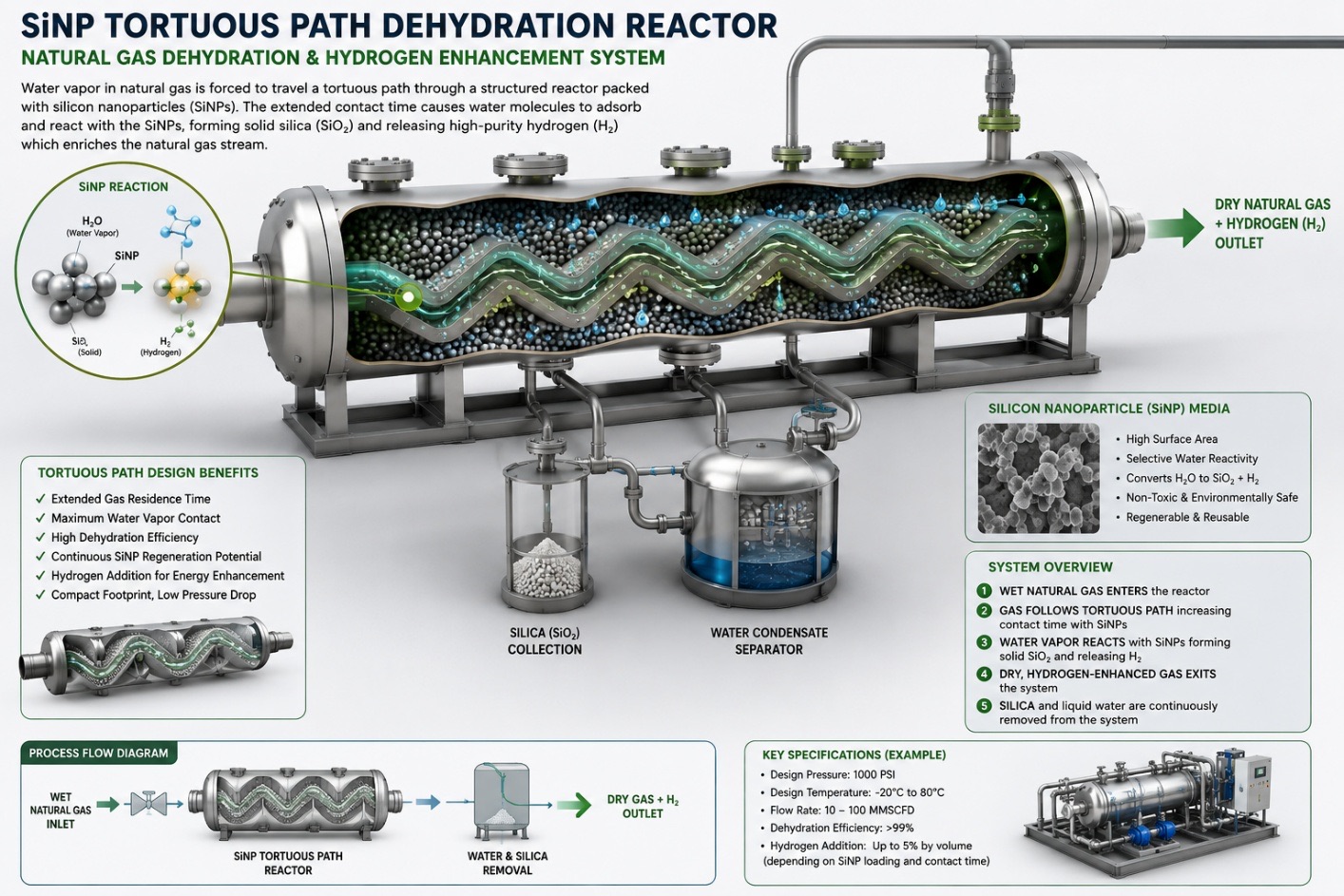
Inside the SiNP dehydration reactor
Wet gas is forced along a tortuous path through a bed of silicon nanoparticles — maximizing contact so water vapour reacts, leaving dry, hydrogen-enhanced gas. A simplified, public view of the skid-mounted system.
From sand to hydrogen
The process, stage by stage
Each stage is labelled by development status, so it's clear what has been validated versus what is still being proven.
- 01Lab-validated
Sourcing silica
The process starts from ordinary silica sand — including reclaimed sand from oilsands sites — an abundant, low-cost input.
- 02Lab-validated
Purifying silicon
A carbothermic process refines silica into higher-grade silicon, removing impurities with heat.
- 03Lab-validated
Milling to fine particles
Silicon is reduced to a fine particle scale so it can react quickly and controllably. Exact specifications are proprietary.
- 04Lab-validated
The water reaction
Silicon reacts with water to release hydrogen gas. University laboratory testing has measured hydrogen purity of ~98% at bench scale.
- 05In testing
Separation & conditioning
Hydrogen is separated and conditioned for introduction into the processed gas stream; solid by-products are recovered.
- 06Projected
Integrated dehydration
Applied to natural gas, the same chemistry captures water vapour while enhancing the stream with hydrogen — in a single skid.
Recovery & regeneration
A closed-loop material cycle
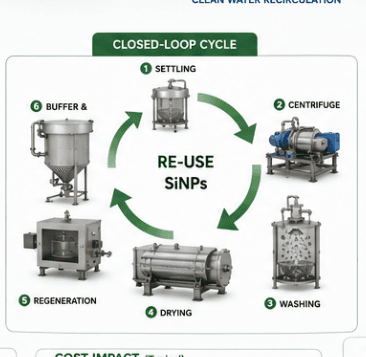
After reacting, the silicon nanoparticles are captured, washed, dried and regenerated — then returned to the process. Silica is recovered as a by-product, keeping material consumption and waste low.
- Settling & separation
- Washing & drying
- Regeneration
- Return to the reactor
How to think about it
Process concepts
The dehydration challenge
Natural gas carries water vapour that must be removed to meet pipeline specification. Conventional dehydration typically relies on glycol circulation, which brings chemical handling, emissions, and maintenance overhead.
The SiFusion concept
SiFusion pairs water-vapour capture with a silicon-based reaction, so the water removed from the gas becomes an input that generates hydrogen — rather than a waste stream to be managed.
Hydrogen introduction
The hydrogen produced is conditioned and introduced back into the processed gas stream, increasing its energy content while reducing reliance on separate dehydration chemistry.
Monitoring & controls
The system is designed for automated operation with process monitoring, pressure protection, and safety instrumentation appropriate to hydrogen service.
A note on claims. The core hydrogen-generation reaction has been independently validated at laboratory scale. The integrated dehydration system is in engineering toward pilot demonstration, and statements about it describe design intent rather than commercial-scale performance. See our Research & Development page for current status.